
News
Stay up to date on the latest crypto trends with our expert, in-depth coverage.


Pfizer Inc (PFE) Announces Positive Results from BREAKWATER Trial
Finviz·2026/02/20 08:39

VICI Properties (VICI) Among the Best Affordable Stocks Under $40
Finviz·2026/02/20 08:39

Wall Street Cautious on Ford Motor Company (F)
Finviz·2026/02/20 08:39

Comcast Corporation (CMCSA) Reports Positive Results From Quantum Computing Trial
Finviz·2026/02/20 08:36

Polymarket Traders Place Huge Bets on Growing Odds of Alien Disclosure by U.S. Before 2027
BlockchainReporter·2026/02/20 08:15

Derivatives Market Hints At Possible Bitcoin Pullback
Cointribune·2026/02/20 08:15
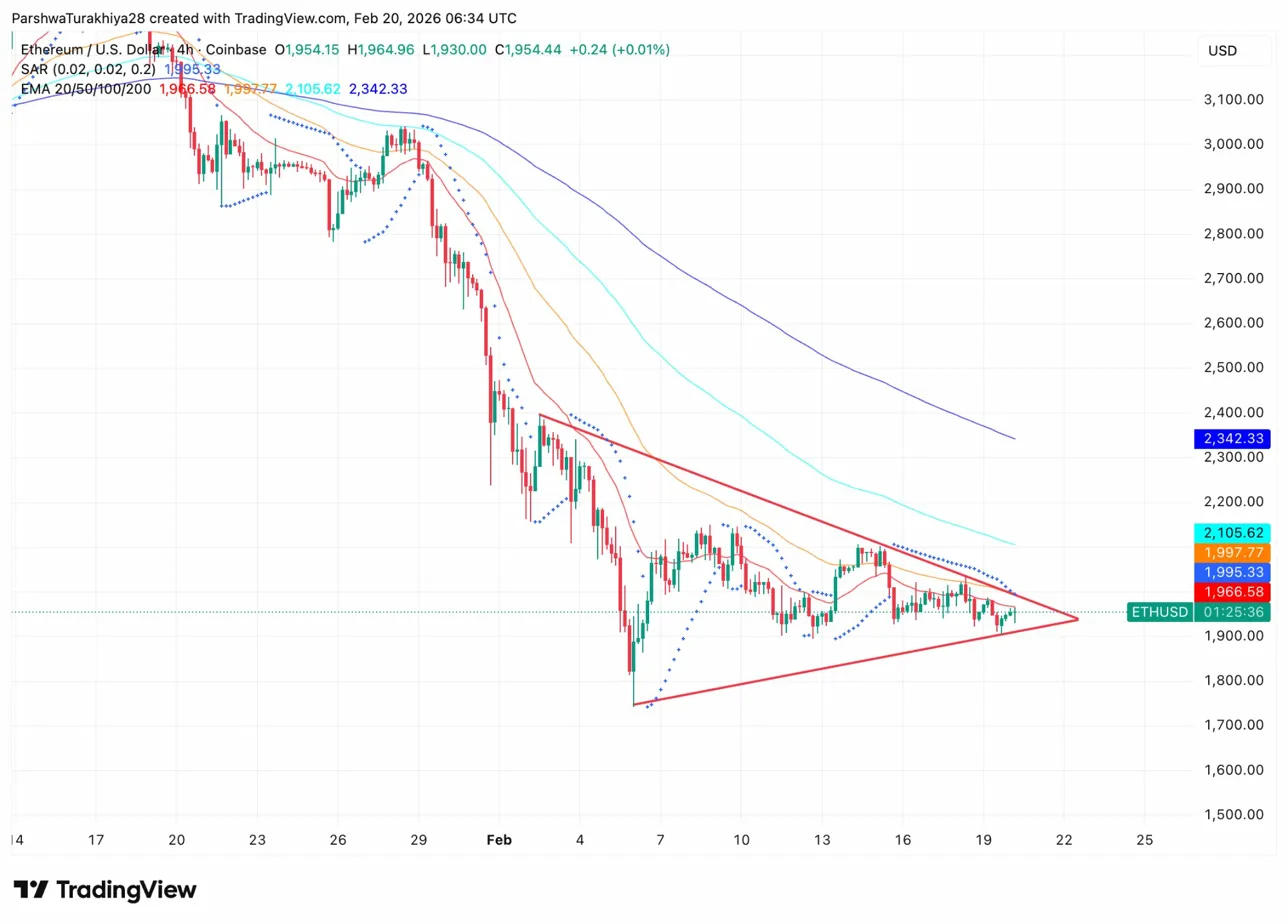
Ethereum Price Prediction: Can ETH Hold $1,900 As Analyst Warns Of 22% Drop?
CoinEdition·2026/02/20 07:52
Whales Accumulate Bitcoin as Network Activity Slows and Market Fatigue Deepens
Cointurk·2026/02/20 07:51
Amazon Edges Past Walmart To Take Fortune 500 Crown For The First Time In 13 Years
Finviz·2026/02/20 07:45
Flash
00:49
Super Data Week Ahead: Non-Farm Payrolls Moved Up to Thursday, US-Iran Conflict Escalates Again, Month-End Rebalancing Amplifies Volatility RiskBlockBeats News, June 28. This week, the global market will face a highly complex situation with multiple overlapping factors: Super Data Week, early release of non-farm payroll data, end-of-month/end-of-quarter/end-of-year institutional rebalancing, and escalating US-Iran conflict, which may lead to a significant surge in market volatility.
On the geopolitical front, despite the ceasefire agreement between the US and Iran, the tense situation has not eased. On Saturday, the US military launched a second round of airstrikes against Iranian targets in response to Iran's downing of a Panamanian-flagged oil tanker "Kiku," which was carrying over 2 million barrels of crude oil. The Iranian Revolutionary Guard then launched missile and drone attacks on Kuwait and Bahrain, warning that any violation of the agreement would trigger a "destructive response." The risk in the Strait of Hormuz has escalated again, putting pressure on oil prices that had previously fallen to around $72. Deutsche Bank has warned that the market is too optimistic about supply recovery, as the inventory levels at the Kharg oil terminal are below the level needed for system stability.
On the data front, due to the US market closure on July 4 for Independence Day, this month's non-farm payroll report will be released early on Thursday, July 2. The market expects an addition of 130,000 jobs in June. This week's data calendar is packed, including Tuesday's JOLTS job openings, Wednesday's ADP employment and ISM Manufacturing PMI, Eurozone's initial CPI for June, and a series of data releases that will impact the market alternately. In addition, the May PCE, released last week, rose to 4.1% year-on-year, reaching a near three-year high, further solidifying expectations of a Fed rate hike later this year.
In terms of asset performance, the S&P 500 index has risen by over 7% in the first half of the year, the Philadelphia Semiconductor Index has surged by 85% from its March low, but the NASDAQ fell by over 4% this week. Gold failed to hold above $1800 under strong US data and inflation pressure, but a Kitco survey shows that both institutions and retail investors are mostly bearish. JPMorgan Chase raised its year-end target for the S&P 500 from 7200 to 7800 this week, but many institutions advise investors to remain cautious as we enter the second half of the year and wait for buying opportunities created by the volatility.
00:48
The number of publicly listed companies holding more than 1,000 bitcoin has increased to 49.A report by Fidelity Digital Assets shows that by the end of 2025, the number of publicly listed companies holding at least 1,000 Bitcoin will increase from 22 at the end of 2024 to 49, controlling nearly 5% of Bitcoin's supply. Strategy holds about 847,000 Bitcoin, Twenty One Capital holds about 43,500 Bitcoin, Metaplanet holds about 40,000 Bitcoin, and MARA Holdings holds about 36,000 Bitcoin. As of early June 2026, between 170 and 199 listed companies hold approximately 1,265,000 Bitcoin, accounting for 6% of the total supply, valued at around $7.6 billion. In May 2026, listed companies had a net increase of 43,557 Bitcoin, with SpaceX included among the holders.
00:44
Fidelity refutes claims that the Bitcoin halving weakens network security: miners' average daily revenue has increased from $26,300 to $40.2 millionBlockBeats News, June 28, Fidelity Digital Assets recently released a research report, directly addressing concerns that Bitcoin halving will weaken network security in the long term. The report's author, Fidelity research analyst Daniel Gray, pointed out that Bitcoin network security is not only dependent on block rewards. Transaction fees, market incentives, and other economic forces also continuously motivate miners to maintain network security and make sustained attacks prohibitively expensive. On the data side, Gray noted that although block subsidies continue to decrease, the increase in Bitcoin’s price has largely offset this effect. The average daily revenue for miners has grown from about $26,300 during Bitcoin’s first halving cycle to more than $40.2 million today. He wrote: "Despite declining issuance, miner incentives—and thus, network security—have historically strengthened in line with rising Bitcoin prices." Since the fourth halving in April 2024, the miner block subsidy has dropped from 6.25 to 3.125 Bitcoin per block. However, the report’s optimistic conclusion stands in stark contrast to the reality faced by publicly traded mining companies. Multiple industry analysts have described the current environment as one of the toughest mining conditions on record, due to a combination of falling block rewards, rising operating costs, and intensifying competition. As a result, many mining companies have begun transitioning into the AI and high-performance computing sectors, leveraging existing electricity infrastructure to meet AI computing demand. VanEck estimates that if publicly listed mining companies want to fully transition to AI infrastructure, they may need to raise as much as $5 billion in additional capital. However, the requirements for data center standards, cooling, power redundancy, and networking are much higher for AI data centers than for traditional Bitcoin mining farms, and the difficulty of this transition should not be underestimated.
News