
Is CFD Copy Trading Risky? An In-Depth Analysis of Bitget CFD Copy Trading
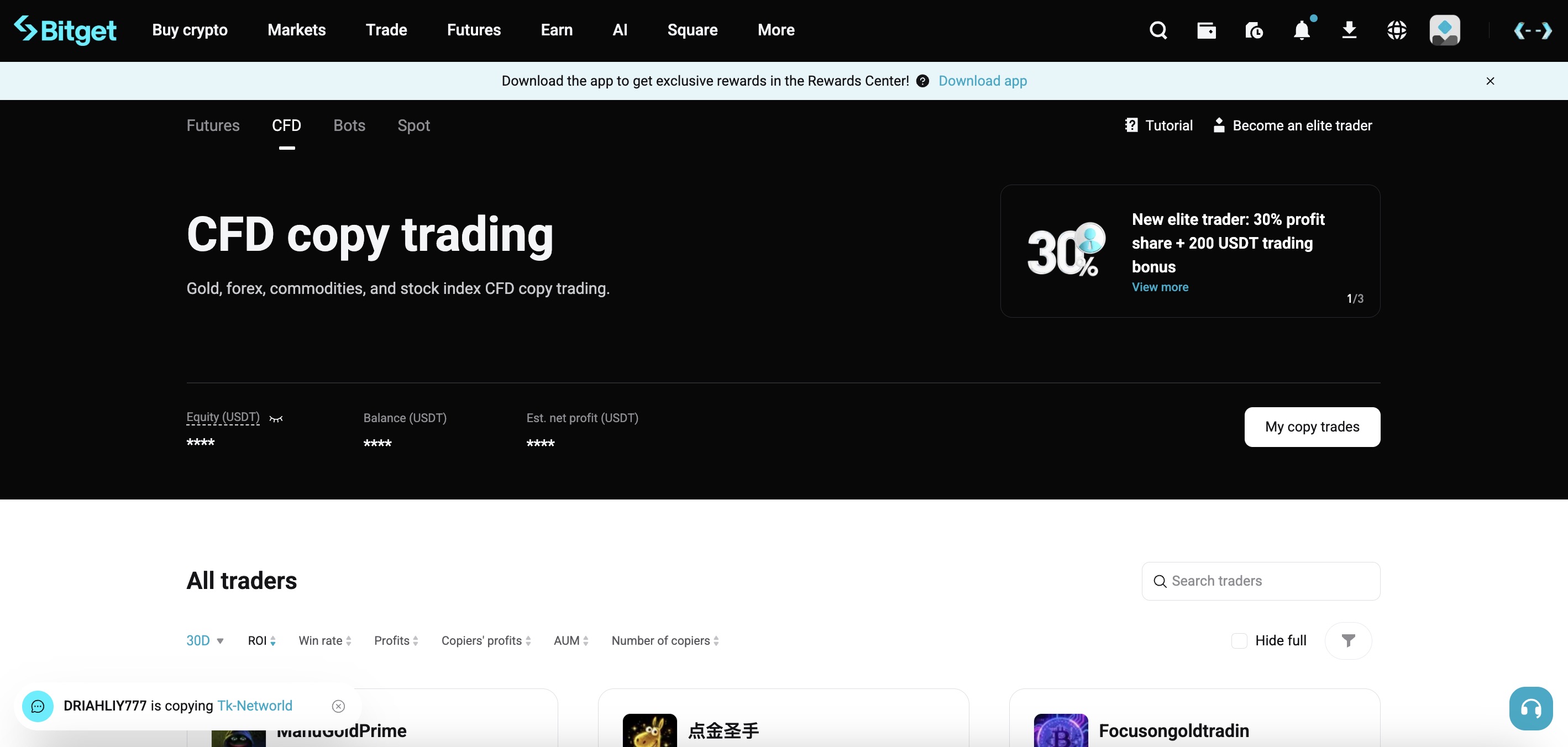
On the Bitget platform, CFD copy trading (Copy Trading) is especially popular, allowing everyday investors to automatically follow the trades of professional Elite traders (Lead Traders). Bitget's CFD copy trading supports markets such as forex (FX), Gold, commodities, and indices, has a low entry threshold (starting from 50 USDT), and offers features such as independent copy trading accounts and risk isolation.
That said, CFD copy trading is not a "guaranteed win" tool, and many users actually experience losses in practice. This article breaks down the product's features, sources of risk, and real-world cases to analyze how to guard against the potential risks of CFD copy trading.
Core mechanics and potential benefits of CFD copy trading
In the Bitget app, go to "Trade," then select "Copy Trading" and "CFD Copy Trading." Users can choose Elite traders and filter them by metrics such as ROI and total profit. The system replicates positions proportionally based on account equity, supports modes such as fixed amount and multiplier, and allows users to set personalized risk controls such as independent take profit and stop loss (TP/SL) and maximum drawdown stop-loss.
These features do lower the barrier to entry, letting beginners participate in global asset trading without having to study the markets in depth. But behind these benefits, leverage amplification, market volatility, and human factors combine to create risk. Past performance does not guarantee future results, and even traders with a strong historical track record can suffer sharp drawdowns during a black swan event.
Does CFD copy trading carry risk?
CFDs are inherently high-risk derivatives instruments, and leverage can lead to rapid loss of principal or even liquidation. While copy trading replicates an expert's trades, it cannot eliminate market risk, liquidity risk, or the risk of mismatched positions. Many users find that after copy trading, their net gains are limited once the profit share is deducted from the trader's winning trades, while they must bear losses in full (after accounting for the profit-share mechanism). In addition, issues such as replication delays, slippage, and mismatched position sizing can amplify losses.
Why does copy trading result in losses?
This is one of the top concerns for many Bitget CFD copy trading users. Copy trading is not a zero-risk, passive investment strategy, and losses usually stem from a combination of factors:
1. Leverage amplification and poor position management: CFD trading relies heavily on leverage. An Elite trader may use position sizes suited to their larger capital base, but if a copy trader with a smaller account uses the "multiplier" mode to replicate trades, this can result in excessive leverage. Even a small adverse market move can then trigger liquidation. In practice, a mismatch in capital size is a common mistake — a small account copying a large trader's heavy positions can quickly lead to losses.
2. Lack of personal risk control: Even though Bitget offers maximum drawdown stop-loss and per-trade stop-loss settings, many users ignore these or set them too loosely. Elite traders may have a higher risk appetite than copy traders can tolerate, and failing to adjust these settings or stop copy trading in time can lead to larger losses.
3. Market volatility and black swan events: CFD instruments such as forex (FX), Gold, and indices are heavily influenced by global economic and geopolitical developments. An Elite trader's strategy may work well in a bull market but fail during extreme volatility or sudden news events. Copy traders cannot intervene in real time, so any losing positions they're copying will directly affect their account.
4. Fees and profit share eating into returns: Copy trading involves costs such as profit share paid to the Elite trader (a cut of the profits), overnight fees, and slippage. Over the long run, even if an Elite trader has a high win rate, net returns can turn negative, especially in choppy markets.
5. Psychological and behavioral biases: Users often chase short-term ROI rankings and switch Elite traders frequently, or add to positions during a drawdown to "average down," breaking their own discipline. Many liquidations occur because users fail to monitor their margin ratio, and insufficient funds cause some orders to fail to copy, further increasing risk.
6. System risk: Although Bitget provides risk isolation, factors such as network latency, insufficient liquidity, or forced liquidation mechanisms under extreme market conditions can still cause outcomes that differ from the Elite trader's actual performance.
In summary, losses in CFD copy trading are usually not a matter of "the Elite trader being bad at trading," but rather a mismatch in risk tolerance between the user and the trader, misuse of leverage, and a lack of discipline.
How to reduce the risks of Bitget CFD copy trading
-
Diversify: Spread your copy trading across multiple Elite traders instead of putting all your funds into a single account.
-
Apply strict risk controls: Set a reasonable maximum drawdown stop-loss, use a fixed-lot mode instead of a multiplier, and regularly monitor your margin ratio and unrealized P&L.
-
Manage your funds carefully: Only use idle funds, start with a small test amount, and avoid chasing performance by switching Elite traders too often.
-
Keep learning: Look into an Elite trader's historical maximum drawdown and trading style, and choose one that matches your own risk profile.
-
Make use of platform tools: Bitget's personalized take profit and stop loss (TP/SL) settings and independent accounts can help you manage risk more effectively.
Conclusion
CFD copy trading carries risk — it can amplify gains, but it can also amplify losses. Bitget provides a convenient entry point, but the key to success lies in the user's own risk awareness and discipline, rather than relying solely on the Elite trader. Losses in copy trading often stem from overlooking the true nature of leverage and failing to properly match one's own risk profile with the trader being copied.


- Core mechanics and potential benefits of CFD copy trading
- Does CFD copy trading carry risk?
- Why does copy trading result in losses?
- How to reduce the risks of Bitget CFD copy trading
- Conclusion
 Micron Reclaims $1,000: Is a Second Leg Higher Beginning?2026-09-08 | 5m
 rToken: 5 ETFs Covering Core U.S. Markets2026-09-08 | 5m
 Top Small-Cap Stocks to Watch2026-09-08 | 5m